Do you need a licence to drive a canal boat?
The complete beginner’s guide to boating without a licence with Le Boat
No, you don’t need a licence to drive a canal boat with Le Boat. Our holidays are built around self-drive boating without a licence, even if you have never done it before. Sounds hard to believe? Just in the last five years, we’ve taught over 75,000 people to drive a boat!
Before you set off, our base team takes you through a thorough handover with everything you need to know from handling the boat, controls, locks, safety, how to moor and knowing what to expect on your route. We also stay available if you need help along the way.
Where local rules ask for a temporary permit or extra paperwork, your Le Boat induction is what makes that possible. Our base team takes you through everything you need to know, then provides the permit or paperwork required for that route.
Being handed the keys to a boat can sound like the sort of thing that should involve paperwork, training courses and years of practice. But a Le Boat holiday is designed for people who have never done this before. Most of our customers are beginners, and that is exactly what our induction is built around. No licence. No experience. Just a proper handover, a little patience, and the kind of pace that gives you time to learn a new skill as you go.
In this article:
Do you need a licence to drive a canal boat?
All Le Boat destinations allow licence-free boating. That means you can drive your own boat in France, the UK, Ireland, Germany, Italy, Belgium, the Netherlands and Canada without a permanent boating licence. Where local rules ask for a temporary permit or specific paperwork, this is handled as part of your Le Boat induction and pre-departure process.
| Destination | Do you need your own boating licence? | Additional information |
|---|---|---|
| France | No. You do not need to arrive with your own boating licence for Le Boat’s self-drive holidays in France, as long as your chosen boat falls within the licence-free waterways category. | In France, inland waterway rules are the same nationwide. You can cruise without your own licence when the boat is within the licence-free category, currently up to 15m with an engine output up to 4.5kW, or 6HP. For boats outside those limits, an inland waterways boat licence is required. |
| United Kingdom | No. You do not need your own boating licence to cruise a Le Boat hire boat in the UK because Le Boat handles the boat’s required waterway licence as the hire operator. | The boat must be licensed for the waterway, and Le Boat handles that as the hire operator. You do not need a personal boating licence, or a test proving your ability, to drive it. You receive a full handover before departure. |
| Ireland | No. You do not need your own boating licence for a Le Boat holiday in Ireland. The boat registration, licence and canal permit are handled by Le Boat, unless the boat is being operated for commercial purposes. | The boat must be registered and licensed, and a permit is needed to access the canals, but Le Boat takes care of that for you. You do not need a boating licence in Ireland unless you are operating a boat for commercial purposes. |
| Canada | No. You do not need previous boating experience or your own boating licence for a Le Boat holiday in Canada. Local age and safety rules apply, and Le Boat explains those conditions before you travel. | Local age and safety requirements apply, and Le Boat explains these before departure. Your induction gives you the route-specific guidance you need before you cruise |
| Germany | You can cruise without your own licence in the Mecklenburg Lake District from Jabel and Marina Wolfsbruch when you complete the Charter Certificate training. Berlin is different: you need a valid boating licence recognised under UNECE Resolution No. 40. | For Berlin routes, you’ll need a boating licence accepted for the area. If you’re not sure whether your licence qualifies, send it to our Sales team before booking and they’ll check it for your chosen route. Around Jabel and Marina Wolfsbruch, you can cruise without your own licence after completing the required Charter Certificate training and your base briefing. Some larger lakes have extra weather and safety restrictions, so you must check with the base before cruising onto them. |
| Belgium, the Netherlands and Italy | No. You do not need to arrive with your own boating licence for Le Boat’s licence-free routes in these destinations. Local rules can depend on the boat’s size, speed, engine power and cruising area, so Le Boat confirms any route-specific conditions before you travel. |
If local rules require route-specific paperwork or a temporary permit, Le Boat confirms this before travel and provides what is needed after your induction. Your booking information sets out any route conditions clearly. In Belgium and the Netherlands, personal licences are generally linked to boat size and speed limits. In Italy, licence-free boating commonly depends on engine power and route conditions. Where temporary paperwork, permits or local restrictions apply, Le Boat explains these before departure and provides what you need after your induction. |
Why do you not need a licence to drive a boat with Le Boat?
Le Boat holidays take place on inland waterways, where the pace is slower, the routes are clearly mapped, and the boats are designed for holiday cruising rather than high-speed handling.
Canal boating is slower than you think: speed limits vary by waterway and region, but Le Boat routes are designed for steady inland cruising rather than speed. You will find the limit for your chosen route in the relevant region guide, usually on the first page alongside the map. This is not the same as taking a boat out to sea. You move at a gentle pace, with time to see what is ahead and enjoy the time with your crew. This slow rhythm is part of what makes the holiday feel so different from driving, flying or trying to fit too much into one day.
Built around beginners, not boating experts
You don’t need to arrive knowing how to steer, moor or use a lock. That’s what the induction is for. Before you leave the base, the team will explain the boat, the controls, the safety equipment, the route and what to do if you need help.
And if you want to get familiar with boat handling, mooring, locks and the other small things that make life on the water feel easier, start with our boating hub. It’s a calm, practical place to understand the basics before you step on board.
“I had never had any boating experience in my life before booking with Le Boat. If you are the same as me then do not worry as Le Boat have you covered. They provide training on how to drive the boats and are helpful all the way along. Everyone on the canal is super-friendly and all boat owners are happy to help and provide information along the way. It really is the friendliest community.“
Thomas, TrustPilot
The waterways are made for this kind of holiday
A boating holiday is about steady progress, not technical performance. You plan short cruising days, stop when you want, and use locks, moorings and waterways that thousands of holidaymakers use every season. You do not need to know everything on day one. The point is to settle into it.
What happens during your Le Boat induction?
We’ll show you how the boat works, moves, turns and stops and what you need to know for your route. You’ll get familiar with the controls, learn how much space to give yourself, find your rhythm as a crew and have time to ask the questions that usually come up once you’re standing at the helm.
Le Boat trains thousands of people to drive boats each year, many of them complete beginners, so the briefing is built around the questions first-timers have. You’ll be shown how to steer, slow down, stop, reverse and give yourself enough space to manoeuvre. The pace is slow, the movements are steady, and you’re not expected to remember everything at once.
“The briefing provided by Mr Dirk Zimmermann was outstanding. He took the time to show us the boat at a relaxed pace and explained everything clearly and thoroughly. He even accompanied us out onto the water, demonstrating everything step by step. Thanks to this professional and reassuring introduction, we were able to start our holiday feeling confident and full of excitement.”
Olga Hardt, Germany
Le Boat’s step-by-step induction process:
- Safety briefing: where the safety equipment is and how to use it.
- Boat handling: how to steer, use the controls, slow down, stop, reverse and give yourself enough space to manoeuvre.
- Mooring: how to slow down, come alongside and tie up properly.
- Locks: how locks work, what your crew should do, and what to expect on your route.
- Route guidance: where to cruise, where to stop, and any local navigation notes.
- Practice: a chance to ask questions before you head off.
- Support: contact details if you need help during your holiday.

Is driving a canal boat safe for beginners?
Yes, when you listen to the briefing, follow the route guidance and cruise sensibly. Most beginners are not worried about the licence itself. They are worried about making a mistake. That is normal.
The honest answer is that small mishaps may happen. You may misjudge a mooring. You may approach a lock more slowly than planned. You may need a second attempt, and that’s totally normal. Take your time, talk it through with your crew and have another go. Fellow boaters and lock operators are usually helpful and friendly, and often happy to lend a hand or offer calm advice if you need it.
The first hour is usually the steepest part of the learning curve. By the end of the first day, most crews have found their rhythm: one person steering, one person looking ahead, someone ready with a rope, everyone talking a little more calmly than they were at the start. If you want a few calm, practical pointers before you set off, read our boat owners advice! They have lots of helpful tips.
The best Le Boat destinations for first-time boaters
The best first route depends on what you want from the holiday. Some people want very few locks. Some want short cruising days and easy moorings. Some want villages, food, swimming spots or wide-open views. The right beginner destination is the one that gives you confidence early.
Shannon & Erne, Ireland

A gentle choice for first-timers who want room to find their confidence. Ireland’s routes are mostly rivers and lakes, so you cruise on wide, open waterways with no commercial traffic, just other pleasure boaters moving at the same easy pace.
Explore the Shannon & ErneLoch Ness & the Caledonian Canal, Scotland
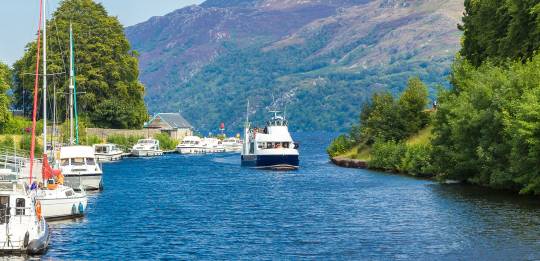
Wide water, big scenery and a strong sense of space. A good choice if you want the feeling of being properly away without a complicated route.
Discover Loch Ness & the Caledonian CanalCanal du Midi, France

Slow mornings, tree shade and villages that make stopping feel natural. Choose your route carefully if you want to keep lock numbers manageable.
Canal boating holidays on the Canal du MidiRideau Canal, Canada

A strong option for first-timers who want lakes, locks and small-town stops, with a route that feels generous rather than rushed.
Cruise the Rideau CanalIf you’re new to boating, our route information and sample itineraries make it easy to choose well. You’ll see cruising times, distances, lock details and suggested stops, so you can plan a first holiday that gives you time to settle in, not rush through.
The freedom is the best part. Once you get comfortable you stop thinking about the controls and start thinking about where to stop for lunch. You notice the towpath, the village, the quiet stretch after the next bend. The boat becomes less of a thing to manage and more of a way to move through the day.
That is the point of a Le Boat holiday. Not boating for boating’s sake. The feeling you get when the pace drops, everyone has something to do, and the day belongs to you.
FAQs: driving a canal boat without a licence
You don’t need experience, but you do need to pay attention. You are still in charge of a real boat, so you need to pay attention, take your time and work as a crew. The good news is that canal boating rewards patience more than confidence.
Most of what you learn is simple: steer earlier than you think, slow down sooner than you would in a car, give yourself space, and do not rush a mooring just because someone is watching. The water teaches you quickly if you let it.
You can’t cruise solo on a Le Boat holiday. Every booking needs at least two adults on board: one nominated captain and one second-in-command. Some larger boats require three adults, so check the crew requirements for your chosen boat before you book. This rule is to keep things calm, safe and workable, especially around moorings and locks.
Couples, families and groups of friends can all make it work. The best crews aren’t always the most experienced. They are the ones who talk to each other, move slowly, and let the holiday become a shared thing rather than one person’s job.
Locks can look intimidating before you’ve used one. In practice, they are part of the rhythm of the holiday. A lock simply raises or lowers the boat between different water levels. They can be manual, electric, automatic or operated by lock keepers, depending on the destination.
All Le Boat routes are suitable for beginners, but each one has its own rhythm. Some include more locks, some have lock-keeper support, and some give you longer stretches between stops. The team can help you choose the one that feels right for your first time on the water.
Ready to explore our boating holiday options?
If you’re still wondering whether you can really do this, start with our boating hub. It explains how self-drive boating holidays work, what to expect on board, and how to choose a route that feels right for your first time on the water.
No licence. No experience. No pressure. Just you, your crew and a slower way to holiday.
Other articles

How to go through a boat lock: step‑by‑step canal lock guide for beginners

Our most experienced boaters reveal their holiday tips