


The most beautiful places to visit in Alsace-Lorraine
Spilling out over 14,000 square kilometres, Alsace-Lorraine spoils visitors with things to do. The list of places to visit in Alsace begins with Unesco-listed cities and continues with centuries-old châteaux, hilltop castles, vineyards, and half-timbered towns.
Many of the region’s highlights can be found close to its waterways. Using the area’s rivers and canals, Alsace-Lorraine holidaymakers can glide between well-known destinations such as Strasbourg and Metz as well as lesser-trodden towns and villages like Saverne – The City of Roses – and historical Pont-a-Mousson.
Here’s our expert guide to the best places to visit in Alsace by boat.
In this article:
Map of the most beautiful places to visit in Alsace-Lorraine
The most beautiful towns and villages in Alsace
Obernai
A half-hour bus ride from Strasbourg, Obernai is lauded as one of France’s 100 most beautiful towns by the country’s official Plus Beaux Détours association.
Enveloped by Medieval city walls with at least 20 towers, the town centre is all half-timbered ‘colombage’ houses, overflowing window boxes, and cobbled streets.
Must-sees include the 60-metre watch tower, the fountain-crowned market square, and the Renaissance-style Six Bucket Well.
Saint-Quirin
One of France’s ‘Les Plus Beaux Villages’ – prettiest villages – Saint-Quirin is beloved for its ‘seven roses’ – a set of historic sanctuaries, chapels, and churches that are sprinkled throughout the village and its neighbouring hamlets.
In the village centre, the Golden Rose is one of the most eye-catching. This priory church has two sky-skimming spires topped with onion domes.
Be sure to also seek out Saint-Quirin’s fountain – its waters are said to have healing properties for the eyes and skin.
Direct trains connect Saint-Quirin to Strasbourg. Or, if you have a bike, you can cycle from Hesse in 50 minutes.
Lunéville
Perched on the banks of the River Meurthe, Lunéville was once the capital of Lorraine. During the18th century, the town was a playground for aristocrats and nobility.
Built as the residence of the Duke of Lorraine in 1702, the town’s grand Château de Lunéville is known as Lorraine’s Versailles. Still the largest 18th-century castle in east France, it’s open to the public, who can tour spaces like the livery and guard rooms, chapel, and formal gardens.
To get here, catch the 20-minute train from Nancy, or make the 35-minute bike ride or 100-minute walk from Einville au Jard.
Lutzelbourg
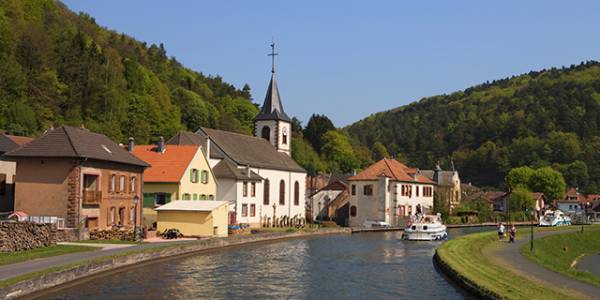
Circled by four forest-furred hills, Lutzelbourg is a town of half-timbered houses and tall spired churches. Overlooking it all, from its rock-top promontory, is an 11th-century castle. It’s largely in ruins today, but it’s still worth the uphill climb. Visitors can take in its 24-metre tower and soak up widescreen views of the Zorn Valley beyond. For more vistas, follow the trail that leads up to the Rocher du Petit Moulin lookout point.
Hochfelden
Surrounded by patchwork fields, Hochfelden is the home of Meteor Beer, an eighth-generation Alsatian brewery. Visitors can take guided tours here, or sample their range of 20 tipples in either the sun-warmed beer garden or modern brasserie.
The family ‘fun walk’ is another must-do in town. Organised by the tourist office, the self-guided walk gives visitors a series of riddles that take them to Hochfelden’s main sights.

Further afield
Whilst dozens of Alsace-Lorraine’s attractions are a hop away from the main cruising routes, there are a few sights a little further from the water. Accessible from Strasbourg by bus or train, in no more than two hours, these destinations are worth traveling the extra mile or two for.
- Riquewihr: barely changed since the 16th century, Riquewihr is officially one of France’s ‘Most Beautiful Villages’. Half-timbered buildings, pastel-paintwork, brimming hanging baskets, and shutter-shaded windows give this place a storybook look. Be sure to see the Thieves Tower – a 14th-century prison – and The Winemaker’s House, where you can see how locals lived in Medieval times. Then stop for a glass of locally grown Riesling in one of the town’s many taverns or wineries.
- Ribeauvillé: neighbor to Riquewihr, Ribeauvillé is one of the oldest Medieval towns in Alsace. Wood-framed buildings, cast iron lantern lighting, and calligraphic street signs are the hallmarks of this photogenic place. Free guided tours that take in sights like the 13th-century Butchers’ Tower, the Town Hall, and the House of the Fiddlers run daily. Or you can just amble across the cobbles and through the town’s fountain-topped squares, with frequent stops at winstubs for a wine or two.
- Eguisheim: just south of Colmar, Eguisheim is built in a spiral shape. Its circular streets are edged by red-roofed, timber-framed buildings, earning it a place on the official list of France’s ‘Most Beautiful Villages’. Eguisheim’s Dovecote building is one of the most-photographed sights in Alsace, and rightly so. Perched on the fork of two streets, its timber frame and wooden staircase make it look like something from a Brothers Grimm book. Visit after dark to see it lit up by lantern light.
- Kaysersberg: the village sits at the foot of a 13th-century castle. Its name translates as Emperor’s Mountain and visitors who climb up to it can take in the cylindrical keep with its four-metre-thick walls and views of thevineyards in the near distance. Elsewhere in town, there are dozens of half-timbered houses to admire, a church with an intricately carved altar piece, and rows of artisan-owned shops. Plus, plenty of traditional winstubs for sustenance.
The most beautiful castles and historic landmarks
Château du Haut-Koenigsbourg
Crowning the hilltop 757 metres above sea level, this imposing castle is more than nine centuries old. Its battlements deliver hundred-mile views over the Alsace plain, Vosges Mountains, the Black Forest and – on very clear days – the Alps.
Visitors access the castle via a drawbridge, and once inside, there are three floors of rooms and exhibition spaces to explore. Highlights include the weapons hall and hunting trophy room.
The easiest way to get here is to take the train from Strasbourg to Sélestat and hop on the shuttle bus to the castle.
Website: haut-koenigsbourg.fr/

The Rocher of Dabo (Dabo Rock)
Anointing a 30-metre rocky outcrop, this 19th-century chapel commands 360-degree views of the Lorainne Plateau and the Vosges Forest.
The rock itself has been a sacred spot since Celtic times, but today’s church is dedicated to Pope Leo IX.
Visitors can climb 62 stone steps to the top of the church’s tower to drink in the valley views as well as see paintings and sculptures on the ground floor inside.
Post or pre-visit hours can be spent exploring the well-marked walking trails and picnic spots that surround the monument. To get here, you’ll need to book a cab or bike ride from Niderviller or Saverne.

Rohan Castle
In the centre of Saverne, this pink sandstone castle has a Neoclassical façade, which – at 140 metres long – is as wide as Strasbourg cathedral is high. It’s this size that earned it the nickname of The Little Versailles of Alsace.
Visitors can take in the scale of the building from its parklands, which also overlook the Marne-Rhine canal. Plus, there’s a museum with galleries on art and sculpture as well as history and archaeology.

Lutzelbourg Castle
The town of Lutzelbourg takes its name from this rock-top fortress, with the old High German words lutzel and burg translating to ‘small castle’. Built in the 11th century, it has belonged to counts and lords and been the subject of dramas and conquests over the years. It’s now in ruins, but visitors can still walk around its once impenetrable walls, take in its 24-metre tower, and absorb the views of the Zorn Valley that surrounds it.

Abbey des Prémontrés
Reflected in the waters of the Moselle River in the town of Pont-a-Mousson, this Baroque abbey dates back to the17th century.
Inside, there are three elegant staircases, an abbey church, and dozens of rooms to discover. In the grounds, meanwhile, visitors will find elegant French gardens, a garden of scents, and a waterside gallery.
Guided tours are available, and events like jazz concerts take place on various evenings.
Website: abbaye-premontres.com
Cultural landmarks and historic sites
Metz Cathedral
Perched on Metz’s Place d’Armes, Metz Cathedral is known as the Good Lord’s Lantern, for featuring the largest expanse of stained glass anywhere in the world.
There are more than 6,000 square metres to see in total, with some pieces dating back to the13th century.
At more than 41 metres tall, the cathedral’s knave is also the third highest in France. Take a guided tour to ensure you don’t miss an inch.
Website: metz.catholique.fr/metz-cathedral
Strasbourg Cathedral
At 142 metres, Strasbourg Cathedral was once the tallest building in the world. Visitors can climb the 330 steps to the roof – where the building’s second spire was meant to be – to take in widescreen views over the rooftops of Strasbourg and Germany’s Black Forest beyond.
If you haven’t got a head for heights, there’s plenty to see on the ground, including an astronomical clock, dozens of sculptures, and the cathedral’s 15-metre rose window, with its 16 stained glass petals.
Website: cathedrale-strasbourg.fr

La Petite France
Part of the wider Grande Île Unesco World Heritage Site, Petite France is Strasbourg’s most picturesque quarter.
The River Isle splits into a series of channels in this part of the city and dozens of timber-framed buildings cast their reflections into the water.
Wandering around here, you’ll take in window boxes frothing with flowers, arching bridges, and the historic buildings where the city’s tanners, millers, and fishermen used to live.
Read all about our recommendations to visit Strasbourg in a day

Völklinger Hütte
A 15-minute bus journey from Saarbrücken, Völklinger Hütte is the world’s only fully preserved ironworks and a Unesco World Heritage Site.
Spanning more than six hectares, the site now encompasses viewing platforms in locations like the former blast furnace, as well as a science museum, art galleries, and a wild garden called ‘Paradise’, which has taken over the old coking plants. Guided tours are available daily.
Website: voelklinger-huette.org
Place Stanislas, Nancy
A key component of Nancy’s Unesco World Heritage Site, this pedestrianised square is the pulse point of the city. Commissioned by a committee of kings and dukes in the mid 18th century, it’s framed by grand Euville stone buildings and a set of intricately welded golden gates. The centre, meanwhile, is anointed by Rococo fountains and sculpture.
A number of cafes have al fresco seating areas that overlook the square. Grand Cafe Foy is one of the oldest – drop by for an aperitif board, charcuterie, escargot, caviar, or a slice of homemade quiche Lorraine.

Scenic routes
The Alsace Wine Route
Trickling down from Strasbourg to Thann, the Alsace Wine Route is a 170-kilometre trail that connects wine towns, wineries, vineyards, wine cellars, and wine estates.
Winery tours, tastings, vineyard picnics, and food and wine pairing experiences are all available in this part of France, which is so highly prized for its Riesling, pinot gris, pinot blanc, and gewurtztraminer wines.
There are dozens of ways to explore the trail, from train and bus to biking and hiking paths. Visit at harvest time (between late August and October) to help with picking.
Scenic Sarreguemines
The countryside around Sarraguemines is stitched with walking trails. There are more than 300 kilometres in total, with routes of between three and 20 kilometres, many of which begin within or close to the town centre.
Trails wend their way past marshland and bogs, across golf courses, along river banks, and through Biosphere Reserves. All routes are outlined on Sarreguemines’ official tourism website.
The Vosges
This 150-kilometre spine of mountains slices through Alsace and Lorraine. Experienced walkers can tackle sections of the 73-kilometre Peak Route, but there are plenty of easier hikes in this region, known for its ‘ballon’ scenery of softly rising and falling hills. Along the Le Boat route, Niderviller or Saverne can be used as springboards into the area.
From the water
You don’t even need to leave the water to experience some of Alsace-Lorraine’s most striking sights.
Saint-Louis-Arzviller Inclined Plane
A popular part of many Le Boat itineraries from Hesse, this boat lift is a feat of engineering. Opened in 1969 to replace a series of 17 locks and a journey that took an entire day, the inclined plane raises boats 44.5 metres and carries them 108 metres horizontally, so cruisers can continue their journey through the Vosges Mountains.
There’s more to this area than the lift, though. You can walk or cycle past the disused locks and duck into the former lockkeepers’ houses, which are now occupied by shops, cafes and art galleries.
Or pay a visit to Cristal Lehrer crystal factory and shop, to see how the area’s signature crystal is made.

Réchicourt Lock (Grande Écluse)
Rising 15 metres above the Marne-Rhine Canal, Réchicourt is a goliath of a lock. Built in the sixties to replace a flight of six traditional locks, it needs 845,000 gallons of water to operate. Its walls are adorned with a bright mural, and there are picnic tables close to the water if you fancy a pause in your journey.

Hidden gems and lesser-known places
Abreschviller railway
A 20-minute taxi ride from either Sarrebourg or Niderviller, the Abreschviller Forest Railway is a 12-kilometre narrow-gauge railway that weaves through the conifer, fir, and spruce trees of the Sarre Rouge Valley.
The journey takes 90 minutes and includes a stop at an authentic ‘Haut-Fer’ sawmill. Trains run from April to October on up to four days a week.
Fruit gardens of Laquenexy
Just 10 minutes outside Metz, these gardens are planted with more than 1,600 fruit trees and 500 smaller fruited shrubs bearing everything from pears, plums, and cherries to hazelnuts and walnuts.
There are edible flower areas, too, as well as a sensory garden. Laquenexy is also one of the only places in the world where you can see ‘marked apples’ – apples grown with stencils on their skins to display a particular image or motif.
Explore Alsace by boat
Thanks to a terrain that shifts from mountain range to valley, from plateau to plain, and with vast swatches of roadless national parks, exploring Alsace takes a little bit of logistical planning. Unless you’re exploring by boat.
The region’s rivers and canals flow unimpeded, connecting towns and cities from east to west and north to south.
Waterways flow in and out of everywhere, from Unesco-listed cities to the dinky towns and villages that look like something from a picture book.
Chateaux, castles, and natural wonders are barely an anchor’s throw away when you explore Alsace by boat.
Discover Alsace-Larraine from a different angle
One of the best ways to see the region is from the water. The area’s canals and rivers place you right in the midst of the region, within easy striking distance of its historic towns, elegant cities, and the myriad walking and cycle trails that contour the countryside.
Undoubtedly, Alsace-Lorraine comes into its own in spring and summer, making these seasons the optimum time for a lazy-paced, wound-down adventure by boat.
The most beautiful places to visit in Alsace-Lorraine: Read our Articles

Where to eat in Alsace-Lorraine: our guide to the best restaurants

Exploring the Canal du Midi with Les Frenchies
