


Burgundy Franche-Comté travel guide: what to see, eat & explore
Pooling out over more than 18,000 square miles of east central France, Burgundy is best known for its wines. Yet there is so much more to France’s second-largest metropolitan region. Traditional market towns of half-timbered houses, chateaux-crowned countryside, and natural parks woven with walking trails are as much a hallmark of the area as its vineyards. Burgundy is also one of France’s culinary heartlands. Not only is the area the birthplace of classic French foods like beef bourguignon and Dijon mustard, but it has a constellation’s worth of Michelin stars.
Homing in on eastern Burgundy, Le Boat’s boating vacation routes offer access to all of the above and even more.
Contents
- Burgundy Franche-Comté main cruising times
- The most beautiful towns and cities to visit in Burgundy Franche-Comté
- Top things to do in Burgundy
Boating in Burgundy Franche-Comté
The eastern side of Burgundy is wrinkled with navigable canals and rivers, from the Canal du Rhone au Rhin to the east, through the central Saône, and the Canal du Bourgogne to the west. The riverbanks of this region are chequered green and yellow with wheat, barley, and sunflower fields. To the south, the waterside is streaked with vines.
Did you know?
You can rent bikes through Le Boat so you can explore more of Burgundy’s wide-open countryside. Reserve them in advance, and they’ll be waiting for you onboard when you arrive. Learn more about Extras
Burgundy Franche-Comté main cruising times
| Cruising from | Cruising to | Cruising time |
|---|---|---|
| Saint-Jean-de-Losne | Chalon-sur-Saône | 8h |
| Saint-Jean-de-Losne | Dijon | 8h |
| Chalon-sur-Saône | La Truchère | 5h 15 |
| Dijon | Châteauneuf | 15h30 |
| Junction of Saône and Canal du Rhône au Rhin | Dole | 4h15 |
| Dole | Besançon | 10h30 |
Burgundy Franche-Comté map and itinerary suggestions (including cruising times).
The most beautifultowns and cities to visit in Burgundy Franche-Comté
Here’s what to expect from the key cities and towns along Le Boat’s Burgundy France Comte routes.
Dijon
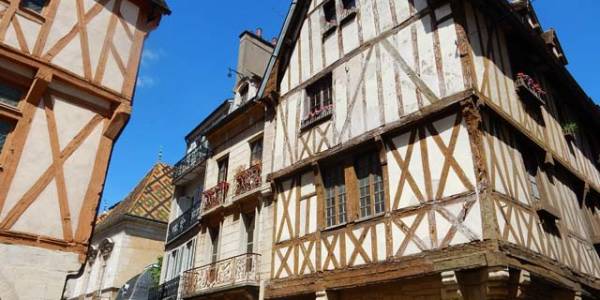
Just an 8-hour cruise northwest from Le Boat’s St Jean De-Losne base, Dijon is Burgundy’s capital city. Known for being both the former seat of the powerful Dukes of Burgundy and The City of a Hundred Steeples, it’s eave to eave with historical monuments, from the grand limestone-clad, column-fronted Palais des Ducs et des États de Bourgogne to the tilting wooden-framed Maison aux Trois Visages.
Dijon is also one of France’s foremost foodie cities. As well as being the birthplace of the namesake mustard, the city is home to the International Cité of Gastronomy and Wine, with its 6.5 hectares of restaurants, bars, and exhibition space dedicated to French food, the elegant arched Les Halles food market, and five Michelin-starred restaurants.
Top tip:
Moor at in the port and you’ll be mere minutes’ walk from the city centre.
Practical information:
- Tourist office website: en.destinationdijon.com
- International Cité of Gastronomy and Wine: https://en.citedelagastronomie-dijon.fr/
Dijon’s 5 Michelin star restaurants:
- l’Asperule: 43 rue Jean-Jacques-Rousseau, restaurant-asperule.fr
- CIBO: 24 rue Jeannin, cibo.restaurant/en
- Loiseau des Ducs, 3, rue Vauban, bernard-loiseau.com
- Origine: 10 President Wilson Square, restaurantorigine.fr
- William Frachot: 5 rue Michelet, chapeau-rouge.fr
Auxonne
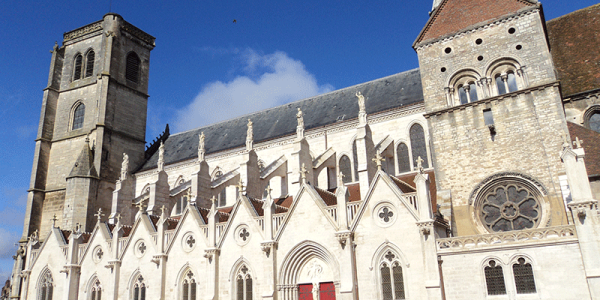
Set in the shadow of the 70-metre twisted spire of the14th-century Church of Notre Dame, Auxonne is a town of red-roofed, half-timbered buildings, cool arcaded walkways, and unevenly cobbled streets. Today’s Auxonne is a placid place, but it hasn’t always been this way. Between the15th and19th centuries, the town played a key defensive role in multiple conflicts. Visitors can still explore and walk the ramparts of the fortress that was continually developed during this period and take guided tours with the tourist office to learn about Napoleon Bonaparte’s connections with the town.
Practical information:
Tourist information centre: capvaldesaone-tourisme.fr
Chagny
The pocket-sized town of Chagny is the gateway to the vineyards of the Cote de Beaune, which are world-renowned for their chardonnay production. Following the car-free Voie des Etangs and Voie de Vignes cycle routes, it’s possible to bike to some of the region’s leading wineries, tasting cellars, and wine estates, including Domaine du Château Philippe le Hardi in Santenay, a six-kilometre pedal away. In the town itself, there’s a 13th century church, an 18th apothecary, and a town square that’s boxed in by bistros and cafes with al fresco seating areas. Celebrating a special occasion? Make a booking at Maison Lemeloise (36 place d’Armes, lameloise.fr/en), which has held three Michelin stars for almost 20 years.

Chagny’s Michelin star restaurant
Maison Lameloise, 36 place d’Armes, lameloise.fr/en
Itinerary tip:
Visit on a Sunday to catch the farmers market in the town centre, when stalls are laden with everything from Ferrari red tomatoes and freshly baked batons of bread to slabs of flavoured nougat.
Besançon
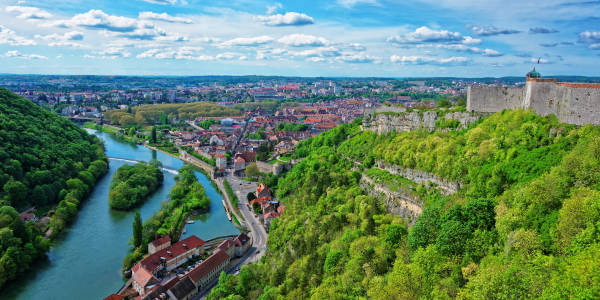
As the historical heartland of watchmaking in France, Besançon is affectionately known as the Capital of Time. Visitors’ own time is best spent exploring the Old Town, which looks like it’s being lassoed by the Doubs River. There are more than 200 18th-century mansions here and a handful of compelling museums from the birthplace of Les Misérables author Victor Hugo to the Museum of Fine Arts and Archaeology, which is the oldest public museum in France. Nesting on the hilltop, 100 metres above the Old Town, the Citadel is worth a look, too. This yawning 17th-century fortress is regarded as a masterpiece of military architecture. It’s possible to walk up to the fort from the town centre, but you can also catch the bus or take the tourist train.
Practical information:
- Tourist information centre: besancon-tourisme.com
- Maison Victor Hugo: maisonvictorhugo.besancon.fr
- Museum of Fine Arts: mbaa.besancon.fr
- Citadel: citadelle.com
Chalon-sur-Saône
One of France’s “Villes d’Art et d’Histoire “(Cities of Art and History), Chalon-sur-Saône is studded with museums and historical monuments. The Orbandale Path self-guided walking route, named after the town’s Medieval title, takes visitors around 20 of them, including the twin-towered Gothic cathedral. Maps of the route can be picked up from the tourist office. Chalon-sur-Saône is also the springboard to Burgundy’s Mâconnais wine region, where the fields are combed with chardonnay and gamay vines. The estates of Laurent Cognard and Domaine de la Luolle are just two wineries that offer tours and tastings within a 20-minute taxi ride (or hour’s bike ride) of Chalon sur Saône.
Practical information:
- Tourist information centre: achalon.com
- Domaine Laurent Cognard: domainecognard.fr
- Domaine de la Luolle: domainedelaluolle.fr

Tournus
Tournus’s claim to fame is that it has one of the highest ratios of Michelin-starred restaurants to residents in the world. Options include L’Écrin de Yohann Chapuis, which is set inside the cool stone exterior of a former orphanage and Aux Terraces, where Burgundian produce is shaved, whipped, foamed, and tweezed into multi-course tasting menu dishes.
Tournu’s Michelin star restaurants
- L’Écrin de Yohann Chapuis: 1 Rue Albert Thibaudet, restaurant-greuze.fr
- Aux Terrasses: 18 Avenue du 23 Janvier, aux-terrasses.com

Mâcon
Multi-coloured houses stand to attention on the waterfront of Mâcon. Beyond them, the twin towers of St Pierre Church, which look like freshly sharpened pencils, and the double spires of the now ruined Vieux Saint Vincent cathedral vie for dominance of the skyline. There are more than 20 sights to see in this southern Burgundian city. To see them all, visitors can follow the Tracé de la Plume or Quill Trail around the city. Don’t leave without trying a Mâconnais wafer, a crisp cigarillo-shaped pastry that’s made from flour, caster, sugar and – surprisingly – cream.
Practical information:
- Tourist information centre: macon-tourisme.com
- Le Tracé de la Plume: walking trail information
Top things to do in Burgundy
Explore The Valley of Gastronomy
More than 100 kilometres of France’s 500 kilometre-long Vallee de la Gastronomie (Valley of Gastronomy) trickles through Burgundy. In total, this foodie corridor incorporates more than 48 products of Protected Geographical Indication, 165 items certified as Appellation d’Origine Contrôlée, the farms, vineyards, workshops, and bistros of dozens of artisan producers, and scores of historical sights linked to food, wine, and culinary culture. Tasting cassis made from locally harvested blackcurrants and sampling Dijon’s eponymous mustard are just two of the gastronomic rites of passage in the region where Le Boat cruises.
Practical information:
Visit valleedelagastronomie.com
Dive deeper into Burgundian cuisine in our foodie guide.
Tour the châteaux
The countryside of Burgundy is crowned with châteaux, with the term referring to both the tall-towered, wall-enwrapped fortified castles of the Middle Ages and the turreted manor houses of the 18th century. Highlights along Le Boat routes include the Gothic revival style Château de Saint-Point, with its porticoes, carved stone, and unusual clock tower that looks like a melting candle, and the gated Château de Digoine, which is set within 35 acres of formal gardens.
For more details on the best château to see and how to reach them from Le Boat moorings read our Burgundy history and heritage guide.
Day trip to a World Heritage Site
Ensconced in 3,000 acres of woodland, just over a 35-minute train ride from Dijon, the 12th-century Fontenay Abbey is protected by Unesco as one of the oldest and best-preserved Cistercian abbeys in Europe. Visitors can pad around the dormitory, chapter house, cloisters, refectory, and forge where the original monks slept, prayed, studied, and worked, and dawdle around the more modern formal gardens, with their fountains, topiary trees, and reflective pools.
Getting there: Catch the train from Dijon to Montbard then make the four-kilometre taxi journey or walk to the abbey.
Go wine tasting
Burgundy is revered for its wines, from the full-bodied pinot noirs of the Côte de Nuit and the complex chardonnays of the Côte de Beaune to the light fruity gamays of Mâconnais. The Burgundian countryside is striped with vines and scattered with wine-producing estates, dozens of which are open for tours and tastings. From Chagny and Chalon-sur-Saône in particular you can cycle to some of the best wineries.
For more details on routes and openings read our Burgundy wine guide.
Discover some of the prettiest villages in France
Cobbled streets, half-timbered homes, shuttered windows, and buildings curtained in ivy are the calling cards of Burgundy’s villages and towns. As are market squares edged with cheese shops, delis, and bistros where seating spills out onto the street.
Discover the best ones to visit with Le Boat in our Burgundy history and heritage guide.
Outdoor activities
Walking and cycling routes lace the Burgundian countryside, leading visitors through landscapes pleated with vines, up to the doors of grand châteaux, and into some of the ‘Grand Sites of France’, which are roughly equivalent to the UK’s Areas of Outstanding Natural Beauty.
For in-depth details on the best trails to follow as well as top fishing and kayaking spots, see our Burgundy outdoor activities guide.
Ready to explore Burgundy Franche-Comté?
Other articles about Burgundy Franche-Comté

Your ultimate guide to the Burgundy wine region by boat

The best outdoor activities in Burgundy: nature, water, and adventure
